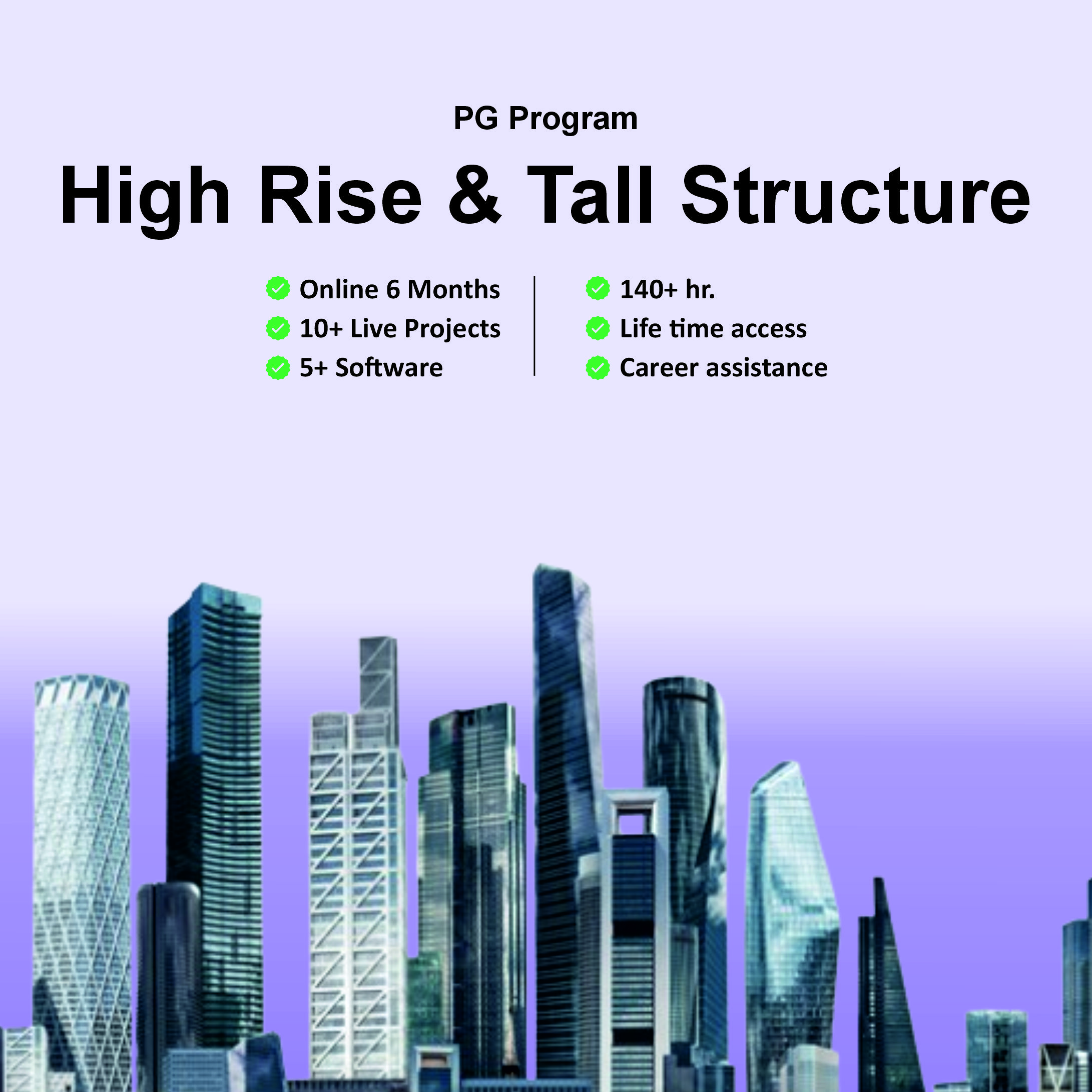


- Description
- Curriculum
Video source is missing or invalid.
Module:01
Topic: Analysis and Design of High Rise Structure with codes concept and software.
Software: CSI ETABS + PER 3D
1.1 Introduction
- Basic Concept designing of Tall building..
- Reading the Architectural, Elevation, Sections for Tall Building.
- Selecting the Structural System.
- Making the structural framing in Auto Cad
- Tall Building Codes
1.2 Specialized Modelling For Tall Building In ETABS
- Tall Building Model Generation.
- Podium Modelling
- Multi tower Modelling
- Basement Modelling
- Core Wall Positioning
1.3 Finite Element Method
- Prepare the FE Model
- I.A discretized (mesh) the structure
- II. Prescribe loads
- Prescribe supports
1.4 Gravity & Lateral Loading Resisting Structural System
- Lateral Load System
- Moment Resisting Frames
- Shear Wall System
- Shear Wall & Frame system
- Frame-Tube System
- Tube in Tube system
- Core wall Positioning
- Gravity Load System
- Flooring System
- Beam Slab System
- Flat Slab System
1.5 Podium Diaphragm, Collectors, Backstay Effects
- Podium & Backstay Effects
- Structural Element of Podium
- Consideration of Backstay Effects
- Design of Diaphragm & Collectors
- Recommendations properties for Modelling of Backstay Effects
- Diaphragm Flexibility.
1.6 Non Linear Modelling
- Basic Approach for Nonlinear Modelling of Structure.
- An introduction to fiber Modelling Approach
- Nonlinear Modelling of material (fibers).
- Fiber modelling of RC Beam.
- Fiber modelling of RC Column.
- Fiber modelling of RC Shear Wall.
- Stress-Strain Relationship-Confined Concrete.
- Stress-Strain Relationship- Cyclic Load.
- The Moment Curvature Curve.
- Hinge Properties.
- Plastic Hinges.
1.7 Wind Analysis –Gust Factor
1.8 Modal Analysis, Damping & Vibration Modes of Tall Building.
1.9 Earthquake engineering of tall building
- Response Spectrum Modal Analysis
- Static Earthquake Analysis.
- The Modal separation of seismic Analysis.
- Conceptual seismic design of Tall buildings
- Seismic Dynamic Behavior of Tall Building
- Seismic Dampers
- Elastic and design demands at the Design Basis
Earthquake Level Using RS method
2.0 Performance Based Design for Tall Building Design
- Performance Based Design Process
- Ritz Vector
- Fast Nonlinear Analysis
- Energy Diagram
- Hysteretic Behavior
- Moment Rotation Relationship
- Capacity Based Design
- Displacement Based Design
- Energy Based Design
- Performance Levels
- Performance Objective
- Performance Parameters
- F-D Relationship
- Backbone Curve
- Hysteresis Loop Model
- ADS Spectrum
- Push Over Analysis
- Time History Analysis
2.1 Mastering the analysis & interpreting the results
Stability check as per code
- Check on lateral Stability
- Check on Vertical Deflection
- Check on Story Drift
- Torsion Irregularities Check
- Soft Story Check
- Check for Over turning Moment
- Check for Control of Deflection
Module: 02
Topic: Design and Analysis of foundation
Software used: CSI SAFE and MS-EXCEL
- Isolated Footing
- Combined Footing
- Raft Foundation
- Pile Foundation
- Raft + Pile
- Software algorithm, capabilities, strength and weaknesses
- Modelling of foundations, basements, footings.
- Design of stirrups .
Design methodology
- Design of fem based slabs.
- Design of slabs, raft & pile .
- Design of punching shear reinforcement (stud rails).
- Detailing, reporting techniques.
- Differential settlement of foundation and its control.
- Combined complex foundation system.
- Punching Shear
- Nonlinear Uplift
- Soil Structure Interaction
Module: 03
Topic: Research and Development of different type of structural system with wind simulation.
Software: CSI SAP2000 and DUBAL RWIND
1.1 Braced Frame and Diagrid System
Braced Frames have much better strength and stiffness Bracing is a much effective than rigid joints at resisting racking deformation of the frame.
1.2 Tube System
The tube is the name given to the systems where in order to resist lateral loads (wind, seismic, etc.) a building is designed to act like a three-dimensional hollow tube.
1.3 Braced Tube System
Also known as ‘Trussed Tube’ or ‘Exterior Diagonal-tube System’ utilized for greater heights, and allows larger spacing between the columns.
1.4 Out trigger structure system
The outrigger truss is a simple trusses spanning over the full height of that story and across the full width of building.
1.5 Diagrid Structure system
The diagrid (a portmanteau of diagonal grid) is a framework of diagonally intersecting metal, concrete or wooden beams that is used in the construction of buildings and roofs.
1.6 Wind Test/Wind Simulation in DUBAL RWIND
RWIND Simulation Case Setup RWIND Simulation software, developed by companies PC-PROGRESS and DLUBAL, was designed as specialized tool for rapid CFD simulations of wind load on large variety of structures. RWIND Simulation works as standalone software, or it can be directly connected with structural design software RFEM or RSTAB. RWIND Simulation user interface is super ease of use with minimal necessary settings and user skills. The work flow is very simple. The input for RWIND Simulation is the surface model of the structure(CAD,.STL). The virtual wind tunnel is created around the structure. Wind speed is set. There st of the parameters are not mandatory, but available.
Wind simulation of following type of software
- Low Rise RCC Structure
- High Rise RCC Structure
- Tall Structure
- Tube Structure
- Iconic Structure
Module: 04
1.1 Reinforcement detailing
Reinforcement details are presented in the form of tables and schedules for groups of components,
as well as drawn in plans, elevations, and sections for individual elements.
Detailing technique according to different CODES (IS, AISC, BS etc.)
1.2 Proof checking for RCC structure
- Structural Forms
- Floor systems (concrete & steel)
- Requirements
- ETABS model checks
- Safe model checks for slab design
- Safe model checks for foundation design
1.3 Assessment
-
4
 Understanding structural framing : 01 (07-04-2025)
 -
5
Understanding structural framing : 02 (07-04-2025)
-
6
G+43 Section Size & Modelling in ETABS with grid (19-04-2025)
-
7
G+43 Section Size & Modelling in ETABS with grid (18-04-2025)
-
8
G+15 , G+25 G+43 Modelling explanation (08-04-2025)
-
9
Code , Loading and their pattern (08-04-2025)


-
77
Shear Wall and Boundary element (17-07-2024): 01
-
78
Shear Wall and Boundary Element (17-07-2024) : 02
-
79
Boundary Element for Core Wall Design (19-07-2024) : 01
-
80
Boundary Element for Core Wall Design (19-07-2024) : 02
-
81
Boundary Element for Core Wall Design (19-07-2024) : 03
-
82
Detailing of structure CSI Detailer 01 (20-07-2024)
-
83
Detailing of structure CSI Detailer 02 (20-07-2024)
-
84
CSI DETAIL AND FOUNDATION (24-07-2024)
-
92
Workshop Introduction (02-12-2024)
-
93
G+15 Hotel Building full explanation
-
94
Pushover Analysis theory concept (04-12-2024)
-
95
G+9 Residential Building Pushover Analysis (07-12-2024)
-
96
Time history analysis process (08-12-2024)
-
97
3B+G+45 High Rise Building analysis with time history (09-12-2024)
-
98
Vibration Analysis (13-12-2024)
-
99
Dampers MODELLING AND ANALYSIS (15-12-2024)
-
100
Outrigger structure system (21-12-2024)
-
101
Diagrid structure system (28-12-2024)
-
102
PBD Performance Based Design : Perf 3D (29-12-2024)
-
103
PBD Performance Based Design Part:02 (10-01-2025)
-
104
Wind PBD (Computational Fluid Dynamics) :25-01-2025
-
105
RWIND Projects execution (24-01-2025)